Yes, but the margin for error is smaller than most people expect. Concrete and cold weather have a complicated relationship. The chemistry that makes concrete harden depends on temperature, and when temperatures drop below a certain threshold, that process slows down significantly or stops entirely. Pour at the wrong time without the right precautions and you won’t end up with a durable slab. You’ll end up with one that looks fine until the first spring thaw, then falls apart.
That said, concrete work happens successfully in cold weather every year. The difference between a winter pour that holds up for decades and one that fails comes down to preparation, the right mix, and protecting the slab during curing. Here’s what that actually looks like in practice.
Yes, Winter Pours Are Possible With the Right Precautions
Fort Wayne’s construction season doesn’t stop in October, and neither does demand for driveways, patios, and flatwork. Experienced contractors who know how to manage cold weather pours can work through much of Indiana’s winter and deliver results that perform just as well as summer work, sometimes better when the slower curing that cooler temperatures allow produces denser, stronger concrete.
The operative phrase is “with the right precautions.” A winter pour without proper preparation is not the same project as a summer pour with the same mix. Ground temperature, air temperature, overnight lows, forecast wind, and planned curing protection all factor into whether a given day is workable and what the crew needs to do differently to compensate for the cold.
How Cold Is Too Cold to Pour Concrete?
The American Concrete Institute defines cold weather concreting as any period when air temperatures fall below 40°F for more than three consecutive days. That threshold exists because concrete chemistry slows meaningfully below 40°F and approaches a full stop below freezing.
In Fort Wayne, that window runs roughly from mid-October through late April, which means the question of cold weather pours isn’t a rare edge case. It’s a standard part of how concrete work gets managed here for six months of the year.
The 40°F Rule of Thumb As The First Guide
The 40°F rule is a starting point, that simply states that concrete can be placed when air temperatures are between 40°F and 50°F if the right mix is used and adequate protection is in place afterward. Below 40°F, there are some additional measures that are required: heated water in the mix, insulated forms, blankets over the slab during curing, or temporary enclosures if temperatures are severe.
The concern isn’t just whether concrete can be placed at a given temperature. It’s whether the concrete will gain enough strength before it’s exposed to a freeze cycle.
Why Overnight Lows Matter More Than Daytime Highs
A day with a high of 48°F can feel workable until you realize the overnight low is 22°F. Fresh concrete that hasn’t gained adequate strength will be damaged by a hard freeze, regardless of what the temperature was when it was poured. The overnight forecast matters more than the daytime conditions for any pour that will still be in the early curing stage when temperatures drop.
This is why experienced contractors check the extended forecast before scheduling a cold weather pour, not just the day’s high.
How Long Fresh Concrete Needs Before It Can Freeze
Concrete needs to reach approximately 500 psi compressive strength before it can safely withstand a freeze without damage. Depending on the mix and temperature during curing, that typically takes between 24 and 48 hours at normal temperatures. In cold weather, it takes longer.
In general, this is what you can expect:
| Air Temperature During Curing | Time to Reach Freeze-Safe Strength | Precautions Needed |
|---|---|---|
| 50°F to 60°F | 24 to 48 hours | Standard protection, insulated blankets recommended |
| 40°F to 50°F | 48 to 72 hours | Insulated blankets required, monitor overnight lows |
| 30°F to 40°F | 72 hours or more | Heated enclosure or heated blankets, accelerated mix |
| Below 30°F | Not recommended without significant heating measures | Full enclosure with supplemental heat, specialist required |
The key takeaway: the colder it is, the longer concrete needs protection, and the more active that protection needs to be.
What Happens When Concrete Freezes Too Soon?
Fresh concrete that freezes before reaching adequate strength doesn’t simply pause and pick up where it left off when it thaws. The water inside the concrete expands as it freezes, disrupting the cement matrix that was forming. The damage is permanent.
Weak, Flaky Surfaces
One of the most common signs of a slab that froze too early is surface scaling: the top layer of the concrete delaminates and flakes off in sheets. It can look like the finish is simply wearing away, but the underlying cause is internal crystal damage from ice formation during the early curing period.
Cracking and Lost Strength
Beyond surface damage (such as cracking, spalling, scaling, pitting, and crazing), when concrete freezes, it loses compressive strength (maximum load-bearing stress concrete can withstand), which can’t be recovered through continued curing.
For example, a slab designed to reach 4,000 psi under normal conditions will only achieve something around 2,500 psi or less if frozen during the first 24 hours. That reduced strength shows up as premature cracking under load and earlier deterioration over time.
How to Spot Concrete That Froze While Curing
Concrete that experienced an early freeze typically shows a few recognizable patterns. The surface has a lighter, almost chalky or powdery appearance rather than the dense, tight finish of properly cured concrete. Scratching the surface with a key or a coin reveals that the top layer is significantly weaker than it should be. Scaling or flaking that begins in the first season after placement, rather than after years of wear, is another reliable indicator. In some cases, a slab that froze early will show a distinct color difference between the surface layer and the concrete below it when a section breaks.
How Contractors Protect Concrete During a Cold Weather Pour
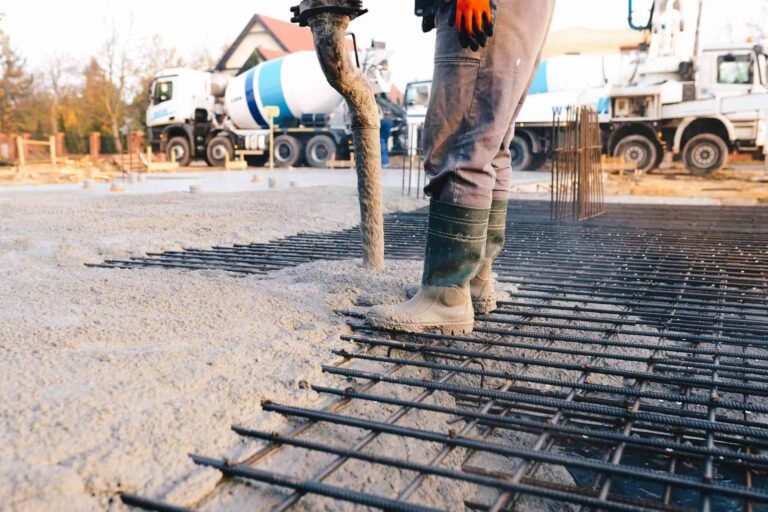
Managing a cold weather pour well is mostly about preparation and timing. The concrete itself can be adjusted for cold conditions, but the work that happens before and after the pour matters just as much as the mix.
Clearing Snow, Ice, and Frost From the Ground
Pouring concrete on frozen ground or on a subbase with frost in it causes problems immediately. Frost in the soil heaves as the ground thaws, lifting and cracking a slab that was placed on top of it. All snow, ice, and frost have to be removed from the pour area before work begins, and the subbase should be checked for frozen material below the surface. In some cases, contractors use heated blankets on the subbase the day before a pour to draw out frost.
Choosing a Cold Weather Concrete Mix
A standard concrete mix isn’t optimized for cold weather. A cold weather concrete mix typically involves a lower water-to-cement ratio, which produces stronger concrete and reduces the amount of freezable water in the mix. Type III cement, which generates more heat during hydration than standard Type I/II, is commonly used for cold weather work because the additional heat helps offset the temperature’s slowing effect on the curing process.
Using Accelerators and Heated Water
Calcium chloride is the most commonly used chemical accelerator for cold weather concrete. It speeds up the hydration reaction, generating more heat and getting concrete to its freeze-safe strength threshold faster. Heated mix water is another standard practice: raising the water temperature increases the concrete temperature at placement, buying more working time before the mix gets too cold to work effectively.
Insulated Blankets and Temporary Enclosures
Once the concrete is placed and finished, the mission is to protect it from heat loss at all costs. Insulated curing blankets cover the slab surface and retain the heat generated by the hydration reaction.
In severe cold, temporary enclosures made from plastic sheeting and frame systems can be erected over a pour, with propane heaters maintaining interior temperatures above 50°F for the duration of the critical curing period.
Planning Around Short Days and the Forecast
Winter days are short, which limits the window for a pour. Concrete needs time to be placed, finished, and protected before temperatures drop in the evening. An experienced contractor plans the pour timing so that the slab reaches its initial set before the temperature falls, and ensures the protection measures are in place before the crew leaves the site.
Cold weather pour checklist:
- Verify a minimum of 48 hours of above-freezing temperatures forecast after the pour
- Remove all frost, ice, and snow from the subbase the day before
- Pre-warm the subbase with heated blankets if frost is present below grade
- Use a cold weather mix with reduced water-to-cement ratio
- Add calcium chloride accelerator or use Type III cement
- Use heated mix water to raise initial concrete temperature
- Have insulated blankets on-site and ready before the pour begins
- Cover the slab immediately after finishing
- Monitor overnight temperatures for the first 48 to 72 hours
- Do not seal or load the slab until adequate strength is confirmed
Curing Concrete When Temperatures Drop
Placing the concrete is only half the job. Curing it correctly in cold weather requires active management rather than the passive process that works fine in summer.
Keeping Heat In Without Drying the Slab Out
Insulated blankets retain heat but they also retain moisture, which is exactly what fresh concrete needs. The concern in cold weather isn’t dehydration, it’s heat loss. As long as the slab stays covered and above 40°F, the hydration reaction continues and the concrete gains strength. Blankets should stay in place for a minimum of three to seven days depending on conditions, not just until the surface looks set.
Why Winter Curing Takes Longer
The chemical reactions that harden concrete are temperature-dependent. At 70°F, concrete reaches most of its 28-day design strength within the first week. At 40°F, the same reactions happen at roughly half the speed. At temperatures near freezing, the process slows to a fraction of normal. This means a cold weather pour needs more time before it can be loaded, driven on, or exposed to traffic, not less.
Holding Off on Sealing Until It Warms Up
Sealing concrete before it has fully cured traps moisture inside the slab that needs to escape as part of the curing process. In cold weather, when curing is already slower, sealing too early is a common mistake that causes long-term surface problems. The general guideline is to wait until the slab has fully cured and temperatures are consistently above 50°F before applying any sealer.
Should You Pour Now or Wait Until Spring?
While waiting until spring is the practical decision most homeowners and project managers face. The right answer depends on the project, the timeline, and the conditions.
In this table, you can see the factors that might be good to consider before starting the project:
| Factor | Winter Pour | Waiting Until Spring |
|---|---|---|
| Scheduling | Often faster, less competition for crews | Peak season backlog, longer wait times |
| Cost | Comparable; some contractors offer off-season pricing | Standard seasonal rates |
| Risk | Higher, requires active management and protection | Lower, fewer environmental variables |
| Prep requirements | Extensive: frost removal, heated mix, blankets | Standard: standard mix, normal finishing |
| Timeline to use the slab | Longer: extended curing period required | Shorter: standard curing timeline |
| Best for | Projects with a hard deadline or new construction schedule | Projects with flexibility and no urgent timeline |
If the project has a hard deadline, an experienced contractor who manages cold weather pours regularly can deliver a durable result. If the timeline is flexible and the project is primarily cosmetic, waiting until consistent temperatures above 50°F arrive is the lower-risk path.
Plan Your Project With Crystal Creek Concrete
Fort Wayne’s winters don’t have to put a concrete project on hold. Crystal Creek Concrete has been managing cold weather pours across Northeast Indiana for over 17 years, with the mix knowledge, equipment, and site preparation experience to produce durable results even when temperatures are working against you. Whether you’re planning a driveway replacement, a concrete patio, or a commercial concrete project on a timeline that doesn’t wait for spring, contact Crystal Creek Concrete for a free estimate.