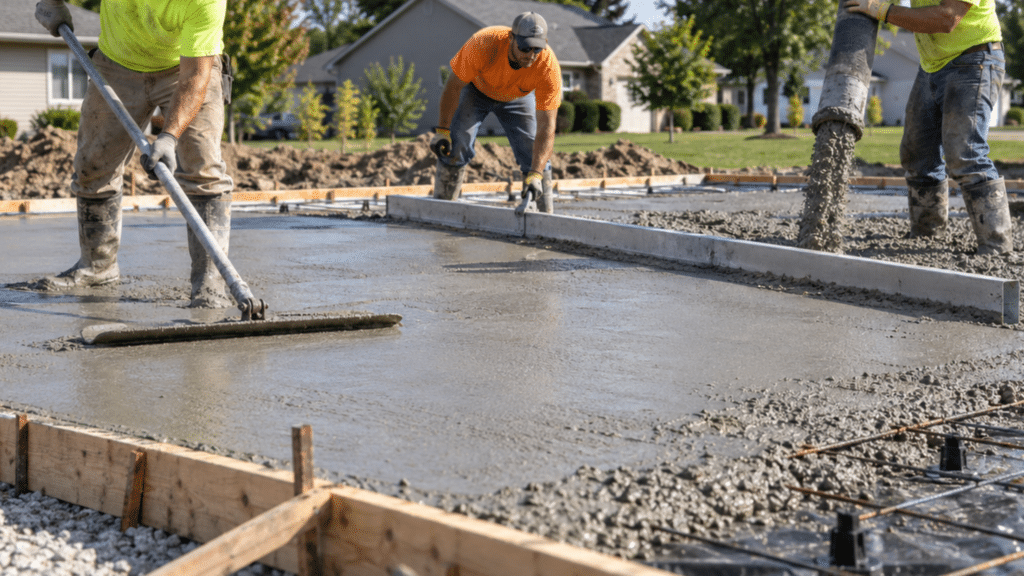
Every building stands on its foundation, and a concrete foundation in Fort Wayne, Indiana has a harder job than most. Allen County sits on clay-heavy soil that swells when wet, shrinks when dry, and freezes dozens of times each winter. A foundation built for those conditions disappears from your life for fifty years. One built wrong announces itself through every sticking door in the house.
This guide covers the three foundation types used locally, what each costs, and how the build actually unfolds. By the end, you should know which type fits your project and what a realistic budget looks like.
Types of Concrete Foundations
Three foundation systems cover nearly every residential and light commercial project in the area. The right one depends on your building, your budget, and what sits under your lot.
Slab-on-Grade

A slab-on-grade is a single thick pad poured directly on prepared ground, with thickened edges that act as footings. It is the fastest and most affordable option, so it is the default for garages, pole barns, workshops, and many ranch homes. The catch is that everything depends on the ground underneath, because a slab has no crawl space to absorb soil movement.
Local clay makes that preparation the whole game. A well-compacted stone base keeps the slab flat through wet springs and dry Augusts. A rushed base shows up later as cracking and settlement.
Crawl Space and Stem Wall

A stem wall foundation raises the structure on short concrete walls, leaving a crawl space underneath. That gap gives plumbers and electricians access for the life of the building, and it lifts wood framing away from ground moisture. The added footings, formed walls, and labor make it cost more than a slab.
Around here, the frost line is the design driver. Footings must reach below the depth where the ground freezes, a depth the county confirms at permit time. That makes stem walls real excavation, not surface work.
Full Basement

A full basement turns the foundation into living or storage space by extending poured walls roughly eight feet down. It is the most expensive option and the only one that adds usable square footage, which keeps it popular for new homes across the region. Waterproofing, drainage tile, and backfill timing matter as much as the concrete itself, because those walls hold back wet clay for decades.
Basement walls also wait for backfill until the concrete gains strength and the first floor ties them together. A builder who rushes that step risks bowing a wall before the house is even framed.
What a Concrete Foundation Costs in Fort Wayne
Foundation pricing scales with excavation depth, formed wall area, and engineering, so the three types land in very different ranges. The figures below are planning ranges for typical residential projects in the area. A firm number takes a site visit, because soil conditions move bids more than any other factor.

Two cost drivers surprise people. Poor soil found at excavation can add engineered fill or deeper footings to any of these numbers, and winter scheduling adds protection costs. Our guide to pouring concrete in winter explains where that premium goes.
What to Expect During the Build
A foundation project follows a sequence that rewards patience at two specific points. Knowing the sequence helps you read whether a crew is doing it right.
Permits and Site Preparation
Foundations are permit work everywhere. Locally that means the Allen County Building Department, which handles building permits for the city and county together. Your contractor should pull the permit, schedule inspections, and build review time into the calendar, and we cover whether concrete work needs a permit separately if you want the fuller picture.
Site preparation follows approval. The lot gets cleared and graded, utilities get located and marked, and the excavation is cut to the engineered depth.
Footings, Walls, and the Pour
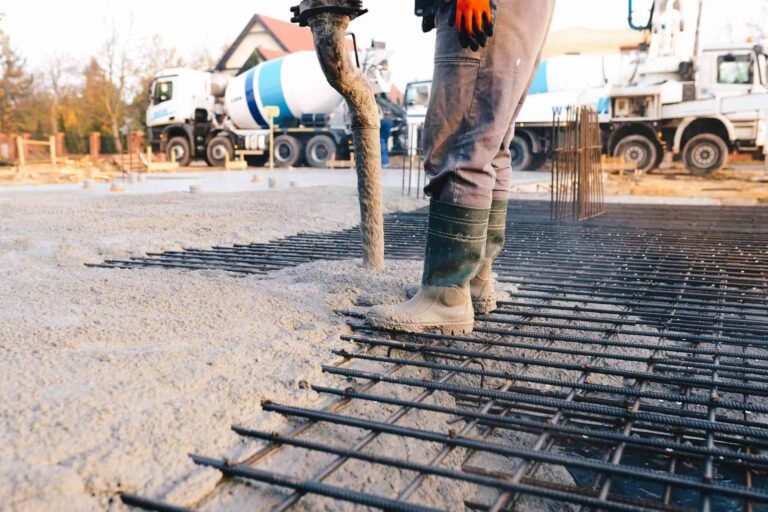
Footings go in first, sized to spread the building’s weight across soil that moves with the seasons. Formed walls or the slab follow, with reinforcement and anchor bolts set before concrete arrives. Inspections happen at set milestones with advance notice, so a well-run project has hold points built in rather than delays bolted on.
The pour itself is a single choreographed day per stage. Concrete arrives on a schedule, gets placed and consolidated, and then the crew’s job shifts from working the material to protecting it.
Curing and the Handoff
Curing is where good foundations are made and rushed ones are ruined. The concrete needs moisture and warmth for its first week, framing typically starts around day seven, and full strength lands near day 28. Those benchmarks come from the American Concrete Institute residential standards. A contractor who mentions them unprompted is a contractor who follows them.
Expect the full sequence to run two to four weeks from excavation to framing-ready, longer in winter. That timeline is normal. Attempts to compress it are where foundation problems begin.
Frequently Asked Questions
How long after pouring a foundation can framing start?
Most builders start framing about 7 days after the pour, once the concrete has reached roughly 70 percent of its design strength. Full design strength arrives around 28 days, which is why heavy point loads and backfilling against basement walls wait longer than the framing crew does. Cold weather stretches both marks, so a late-season pour adds days to the schedule rather than shortcuts.
Can a foundation be poured in winter in Fort Wayne?
Yes, foundations go in all winter here with ground thawing, heated enclosures, and adjusted mixes. Builders often prefer not to lose a season waiting on weather, and a protected winter pour reaches the same strength as a summer one. The tradeoff is cost, since the protection typically adds 10 to 20 percent to the concrete work.
What are the warning signs of foundation problems?
Watch for stair-step cracks in block or brick, doors and windows that suddenly stick, sloping floors, and horizontal cracks in basement walls. Hairline vertical cracks in poured concrete are common and usually cosmetic, while horizontal cracking signals soil pressure and deserves a professional look quickly. Around here, most movement traces back to clay soil swelling and shrinking with moisture, so gutter and grading fixes are often part of the answer.
Build on Ground You Can Trust
The foundation is the one part of a project you cannot economize on twice. Crystal Creek Concrete has poured concrete foundation services in Fort Wayne and across the surrounding counties for over 17 years, on clay lots, tight timelines, and January schedules alike. Call or text (260) 241-4936 or request a free estimate online. We will look at your site, your soil, and your plans before putting a number on any of it.