Almost every homeowner with a concrete driveway or patio has stood over a crack at some point and wondered the same thing: is this normal, or is something wrong? The honest answer is that it depends entirely on what caused it, because concrete cracks for several different reasons, and not all of them are a sign that the installation was poor or that the slab is failing.
Understanding why concrete cracks in the first place is what separates a homeowner who panics over a hairline shrinkage crack from one who recognizes a drainage-related structural crack for what it actually is. This post covers the most common causes, what each type of cracking typically looks like, and what can actually be done at the installation and maintenance stage to reduce the likelihood of serious cracking over a slab’s lifespan.
The Basic Reason Concrete Cracks at All
Concrete is strong in compression, meaning it handles weight and downward pressure very well. It’s considerably weaker in tension, meaning when forces pull or stretch it from different directions, it resists less effectively. Most cracking happens when tensile stress in the slab exceeds the concrete’s ability to hold together at that point.
Fun Fact: Concrete actually begins shrinking the moment it starts curing, and this shrinkage creates internal tensile stress before any outside force, vehicle weight, soil movement, or weather, has ever acted on the slab, which is why control joints are deliberately placed to give concrete a planned location to relieve that stress rather than cracking randomly.
That internal shrinkage during curing is one reason concrete always has the potential to crack, even when everything is done correctly. The goal of good installation isn’t to make concrete that will never crack anywhere, it’s to make concrete that cracks predictably, at control joints, rather than unpredictably across the middle of the slab.
The Most Common Causes of Concrete Cracking
Shrinkage During Curing
This is the most normal type of cracking, and the one most often mistaken for a problem when it isn’t. As concrete dries and cures, it loses moisture and contracts slightly. If that contraction is restrained, even just by the friction between the slab and the ground beneath it, tensile stress builds up and cracking can occur.
Hairline shrinkage cracks that appear shortly after installation and don’t widen over time are typically a normal byproduct of this process rather than a structural concern.
Freeze-Thaw Cycles
Quick Fact: In Fort Wayne and across Northeast Indiana, concrete can go through dozens of freeze-thaw cycles in a single winter, each one expanding and contracting the slab slightly as water inside the concrete freezes, expands, and then thaws, and that repeated stress is one of the primary reasons driveway and patio cracks develop faster here than in warmer climates.
Water that has worked its way into small pores or existing hairline cracks expands by roughly nine percent when it freezes. Over many cycles, that repeated expansion widens small cracks into larger ones and can eventually cause surface spalling, where the top layer of concrete begins flaking away.
Base or Subgrade Failure
This is the category of cracking that actually signals a serious structural problem. When the soil or base material underneath a concrete slab shifts, settles unevenly, or erodes due to poor drainage, the slab loses support in certain areas and cracks under its own weight and any load on top of it.
Unlike shrinkage cracks, which tend to be relatively fine and consistent, base failure cracks often cause sections of the slab to become uneven, with one side sitting higher than the other. This is the pattern that typically points toward replacement rather than surface repair.
Concrete Installation Mistakes
Fast Fact: Two of the most common installation mistakes that lead to premature cracking are adding too much water to the concrete mix to make it easier to work with, which weakens the final slab, and placing control joints too far apart or too shallow, which allows random cracking to occur between them instead of at the planned relief points.
Other installation factors that increase cracking risk include insufficient slab thickness for the intended load, inadequate base compaction before pouring, and curing too quickly in hot or dry conditions without proper moisture management.
Tree Roots and Organic Growth
Roots from nearby trees, especially species with aggressive root systems, can push upward against a concrete slab over years and cause significant heaving and cracking. This type of damage is often gradual and easy to miss until the root intrusion is well advanced.
Drainage and Water Intrusion
| Drainage Issue | How It Leads to Cracking |
|---|---|
| Poor slope or grading | Water pools under the slab, softening the base over time |
| Missing or blocked drainage | Chronic moisture erodes subgrade, creating voids beneath the slab |
| Downspout discharge onto concrete | Concentrated water flow accelerates freeze-thaw damage |
| No vapor barrier under slab | Ground moisture works into the slab from below |
Poor drainage is one of the most underappreciated contributors to long-term concrete deterioration, because the damage happens invisibly over months and years before the surface shows any sign of it.
What Can Actually Be Done to Prevent Cracking
Some cracking is inevitable in any concrete surface over a long enough time horizon. But the rate at which serious cracking develops, and whether that cracking stays manageable or becomes structural, is heavily influenced by decisions made at the installation stage and how the surface is maintained afterward.
At the Installation Stage
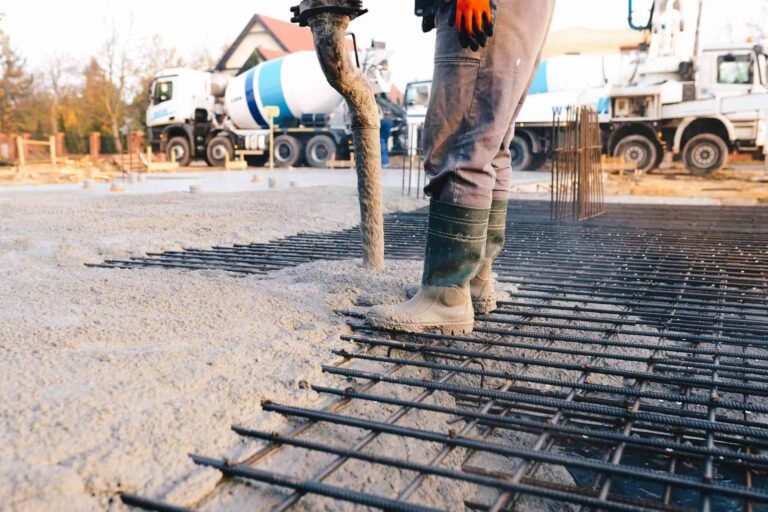
Proper base preparation matters more than almost any other factor. A well-compacted, stable base gives the slab consistent support across its entire surface, which is what prevents the differential settling that causes uneven cracking. Correct slab thickness for the intended use, appropriate reinforcement, well-placed control joints, and a concrete mix that isn’t over-watered all contribute to a slab that performs closer to its full potential lifespan.
These aren’t extras or upgrades. They’re the foundational execution decisions that separate concrete that lasts 30 years from concrete that starts showing serious problems in 10. The concrete installation mistakes listed above, over-watering the mix, shallow control joints, inadequate compaction, are also why choosing a contractor with consistent technique matters as much as price.
Through Ongoing Maintenance
Sealing a concrete surface every few years is one of the more impactful maintenance steps available to homeowners. A quality sealer reduces the amount of water that can penetrate the surface, which directly limits how much freeze-thaw damage accumulates over time. It also helps prevent de-icer chemicals from working into the concrete and accelerating surface deterioration.
Addressing small cracks early matters too. A hairline crack that gets sealed promptly stays manageable. The same crack left open through a Fort Wayne winter lets water in, which expands during freeze-thaw cycles, widens the crack, and sets a deterioration cycle in motion that becomes progressively harder and more expensive to reverse.
For guidance on how to assess what a specific crack actually means for your slab, concrete repair vs replacement walks through the decision clearly, and what concrete repair and replacement actually costs gives you realistic numbers for whatever path makes sense for your situation.
When Prevention Has Already Passed
For homeowners reading this because a crack has already appeared, the most useful thing to know is that the cause matters more than the appearance. A visually dramatic but structurally harmless shrinkage crack and a subtle but serious base failure crack can look similar to an untrained eye while pointing toward completely different responses. A proper assessment from an experienced contractor is almost always worth more than trying to diagnose it from a photo or a general description.
Get the Installation and Repair Work Done Right in Fort Wayne
Understanding why concrete cracks puts you in a better position to ask the right questions before a project starts and respond to the right signals after it’s done. Crystal Creek Concrete has been installing and repairing concrete surfaces across Fort Wayne and Northeast Indiana for over 17 years, with the kind of base preparation, mix standards, and control joint placement that gives slabs the best realistic chance at their full lifespan. Whether you need concrete repair on an existing cracked surface, a full driveway replacement done correctly from the base up, or a new concrete patio installed to last, contact Crystal Creek Concrete today for a free estimate and a straightforward conversation about what your property actually needs.